


Ancient Beginnings
The preparation and consumption of bread-like products can be traced back at least 14,000 years, predating the emergence of agriculture by some 4,000 years. From the southwestern Asian heartland, wheat cultivation spread eastward. Ancient wheat recovered in nomadic campsites in Kazakhstan shows that prehistoric herders in Central Eurasia had incorporated the crop into their economy nearly 5,000 years ago, pushing back the chronology of interaction along the territory of the Silk Road by more than 2,000 years.
Wheat reached China through these same corridors. Recent discoveries show that wheat arrived in northern China as early as the mid-third millennium BC, after passing through Central Asia, established in northern China from as early as the Eastern Zhou period around 771 BC, and flourishing further after the Han Dynasty when stone mills made flour-grinding more practical. The result was mantou and bing, steamed and pan-cooked wheat breads that remain staples today.
In South Asia, a parallel tradition emerged around a very different technology. Archaeologists in Rajasthan have unearthed tandoor ovens dating back to 2,600 BC. Since antiquity, tandoors were used to bake unleavened flatbreads such as roti and naan, spreading from the Indian subcontinent across Central and Western Asia.
Wheat and fire-based technology was already know for millenia in Asia, then the Europeans came and brought leavening techniqus and closed oven-baking and bread making in Asia started a new trajectory.
European Bread-Making in Asia
The Iberians
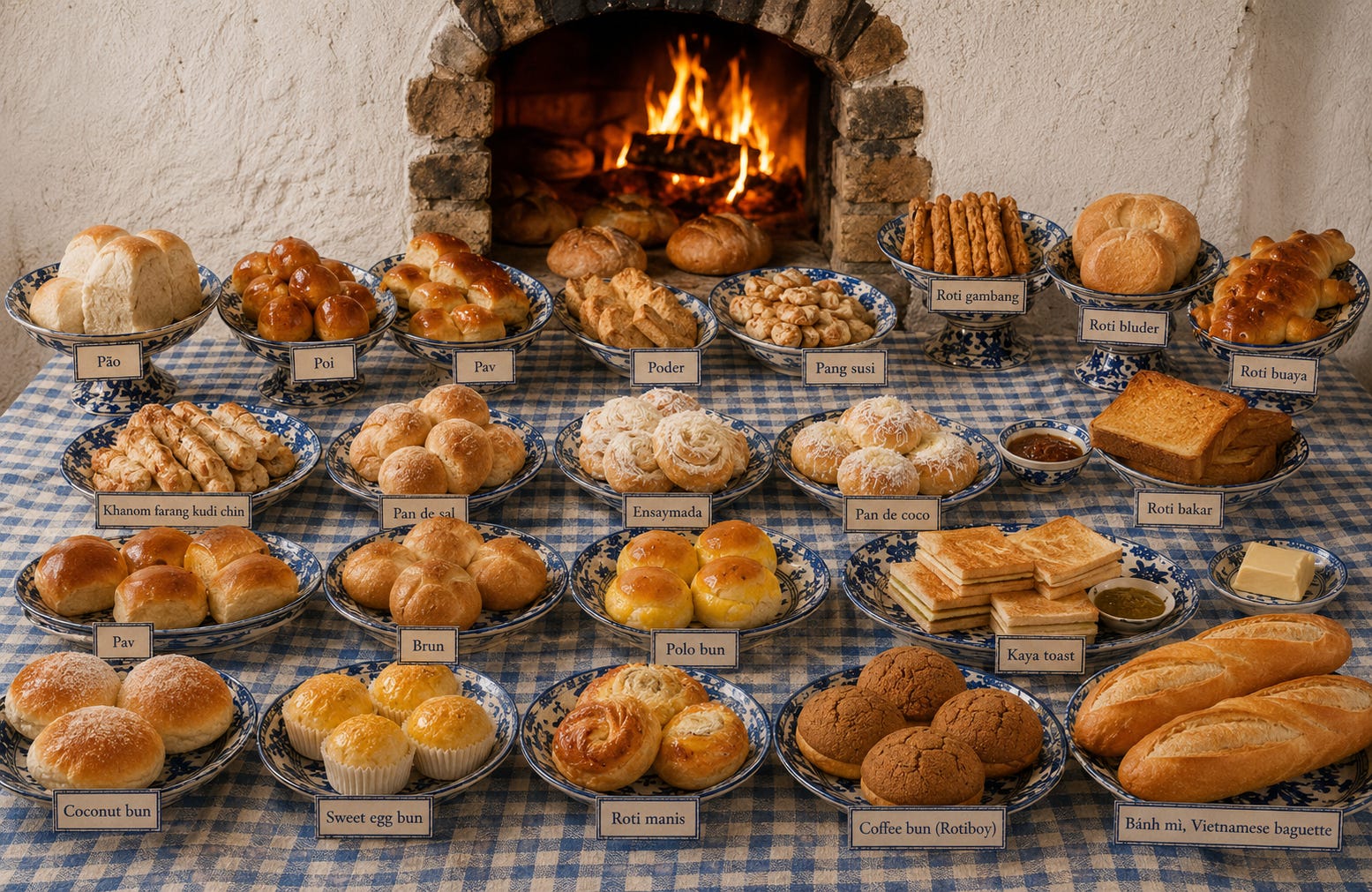
The first European bread to reach Asia arrived from the Iberian Peninsula by two separate oceanic routes almost simultaneously. The Portuguese dominated the Indian Ocean, establishing its Estado da India from Goa (1510) westward to Hormuz and eastward to Malacca and Macau. The Spanish meanwhile, crossed the Pacific, colonising the Philippines from 1565 linking Acapulco to Asia. Both were Catholic maritime empires driven by the same combination of missionary purpose and commercial ambition, and both carried bread — as sacramental necessity and daily sustenance into their Asian territories at the same historical moment.
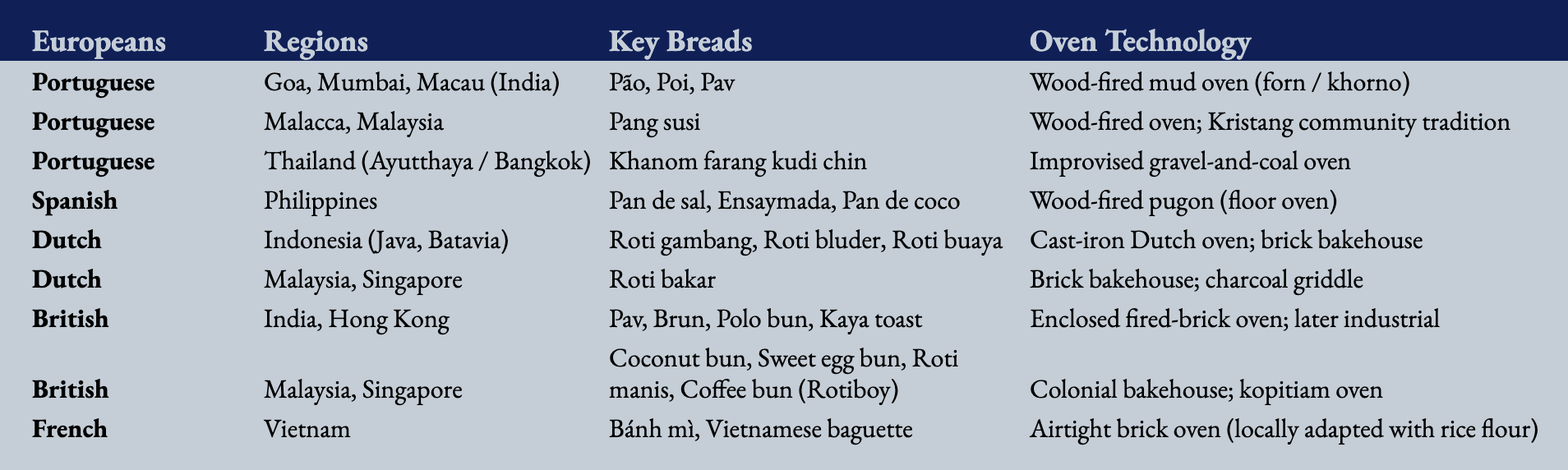
The oven the Portuguese brought to Goa was the wood-fired mud oven, known locally as the forn derived from the Portuguese word forno, a domed or vaulted structure built from clay and brick, preheated by burning wood inside the chamber until the walls and floor reached baking temperature. The fire was then raked out, the dough loaded onto the hot floor using a long-handled wooden peel, and the entrance sealed to retain heat.
Goa: The Goan pão is baked in wood-fired hole-in-the-wall mud ovens known as khorns in Konkani, which give it its characteristic texture and distinctively smoked flavour and aroma. The Goan breadmaker, known locally as poder, an adaptation of the Portuguese padeiro, became for centuries the province of the Catholic community, a family tradition handed down over generations. The leavening agent itself was adapted from local toddy — fermented coconut sap, known as sur, a natural yeast, giving the bread a distinctive character. This fusion of Portuguese oven technology with Indian ingredients produced a bread that was European in structure but Asian in character.
Mumbai: The Pav is the direct urban descendant of the Goan pão, carried to Bombay by Goan Catholic bakers migrating in search of work. Pão wove its way into the heart of Goa’s cuisine and then made yet another journey — Goan bakers carried their skills to Mumbai, then Bombay, where the bread became the city’s own. Today it is the structural foundation of iconic Mumbai street foods — vada pav, pav bhaji, and keema pav — eaten daily by millions, its Portuguese ancestry fully evolved into it’s new identity as the quintessential working-class breakfast or lunch
Philippines In the Philippines, the Spanish replicated a closely parallel process structurally similar to Goan breads: small rolls, slightly fermented, baked in wood-fired ovens. Spanish friars grew wheat in Cagayan Valley, Ilocos provinces and Calatagan, milling it into flour for bread and eucharistic wafers, and from these friars, Filipinos learned to bake. The first pandesals were modelled on the baguette — made with whole wheat flour and baked in a pugon, a wood-fired oven resting on the floor — known as pan de suelo, or floor bread. The modern version evolved softer and sweeter as locally available lower-protein flour replaced whole wheat, and today pan de sal is the universal Filipino breakfast bread, eaten across all social classes and all regions of the archipelago.
There’s also the ensaymada — a brioche-like roll topped with cheese and buttercream that traces its origins to Mallorca — and pan de coco, a soft roll with a sticky sweet coconut filling. Both remain fixtures of the panaderia, the neighbourhood bakery whose very name is a Spanish inheritance.
The Dutch


Commerce, Colonialism, and the Bakery as Institution
Where the Portuguese arrived as missionaries and traders, the Dutch arrived as systematic colonisers, and their impact on Asian bread culture was correspondingly more durable. From the early seventeenth century, the Dutch East India Company established a network of fortified trading posts and colonial settlements stretching from the Cape of Good Hope to Nagasaki. In each settlement, the practical demands of feeding European soldiers, sailors, and administrators meant that organised bakeries were among the earliest institutions established.
In Batavia, Dutch-style wheat bread became a fixture of colonial life, and over time local populations employed in and around colonial households became familiar with European baking techniques and equipment.
In Ceylon Dutch colonialism from the mid-seventeenth century similarly embedded European bread into coastal urban life, leaving a tradition of bakeries in Colombo and Galle that outlasted the VOC itself.
In Japan the Dutch were the sole European nation permitted to trade with Japan during the Edo period, operating from Dejima in Nagasaki harbour from 1641. While their direct culinary influence in Japan was tightly restricted, this channel kept a thin thread of European food knowledge alive during Japan’s long isolation, and Dutch technical literature on baking and milling was among the Western knowledge that Japanese scholars studied through rangaku — the study of Western science via Dutch sources.
Bread’s more substantial adoption into the Japanese diet began during the Meiji Restoration in 1868, an era in which Japan actively sought to modernise through rapid industrialisation and cultural westernisation, with consumption initially in regions with larger foreign settlements such as Yokohama, where immigrant-run bakeries opened and Japanese workers learned to bake Western bread before their skills spread to other parts of the country.
Brass Pots, Cast Iron, and the Colonial Bakehouse
Where the Portuguese introduced an oven built into the wall of a building, the Dutch brought a fundamentally different baking technology, one designed for portability and the practical realities of maritime and colonial life. The Dutch oven was a heavy, thick-walled cooking pot with a tight-fitting lid, originally cast in brass using a sand-moulding technique refined in the Netherlands during the seventeenth century.
In 1707, the Englishman Abraham Darby obtained a patent for the process of casting iron in sand, which derived from the Dutch process — and the term “Dutch oven” has endured for over 300 years. The pot worked on a principle of enclosed, retained heat: placed directly over coals or an open fire, with additional hot coals heaped onto its flanged lid, it created a miniature oven environment capable of baking bread, roasting meat, and slow-cooking stews.
In Asia the Dutch oven required no fixed structure, no kiln-built chamber, and no specialist construction — it could be used aboard a VOC vessel, in a jungle trading post, or in the early stages of a new settlement before permanent bakehouse infrastructure existed. A
As Dutch settlements matured, permanent colonial bakehouses were constructed along European lines, using brick-vaulted ovens similar to the Portuguese forn but on a larger, more institutional scale. These brick ovens were arched chambers built at waist height, fired with wood until the masonry walls reached the required temperature, then cleared of ash and loaded with bread.
Dutch colonial baking in Indonesia was defined less by the everyday loaf and more by the enriched, spiced, and long-fermented dough that reflect both Dutch pantry ingredients and the aromatic spices of the Indonesian archipelago itself.
Semarang: Roti gambang is a rectangular brown bread with sesame seeds, flavoured with cinnamon and palm sugar, recognised as both a Betawi traditional bread from Jakarta and a Javanese bread known as roti ganjel rel in Semarang, where it is typically served during Dugderan, Ramadan, and Eid ul-Fitr. It is believed to be a descendant of the Dutch Ontbijtkoek which locals ingeniously adapted using available ingredients, including cassava as a substitute for wheat flour, producing a dense, chewy bread they named after the xylophone-like gambang instrument it resembled.
Java: Roti bluder, derived from the Dutch bloeder, is a classic Indonesian bread characterised by its very soft and fluffy texture. The original old-fashioned version required 16–24 hours for the full baking process. Its long fermentation and enriched dough of egg yolks, sugar, milk, and butter reflect a directly transplanted Dutch enriched-bread tradition, adapted over centuries into a distinctly Indonesian product.
Jakarta: Roti buaya or crocodile bread, is a Betawi sweetened bread shaped like a crocodile, always present in traditional Betawi wedding ceremonies. Before the Europeans introduced bread, the crocodile-shaped ceremonial dish had been made from yam or cassava. The bread then absorbed European baking technology into indigenous ritual culture with the European leavened loaf literally taking the shape of a local symbol of marital fidelity.
The English
British colonial expansion across Asia brought European bread-making to its widest and most institutionally embedded presence on the continent. Unlike the Portuguese, whose influence was maritime and missionary, or the Dutch, whose reach was primarily commercial, the British established a form of territorial governance that penetrated deep into the social fabric of conquered societies.
In India, where the British East India Company had been operating since the early seventeenth century and where Crown rule was consolidated after 1858, bread became a marker of colonial modernity. European-style bakeries proliferated in the garrison towns and civil stations that the British constructed across the subcontinent: Calcutta, Bombay, Madras, Lahore, and dozens of smaller cantonments, and bread was a daily necessity for British officers, administrators, and their households.
Over time, a class of South Asian bakers emerged, often called pao-wallahs, who supplied both European and increasingly local customers. The word pav — still used for the soft bread roll central to Mumbai street food such as vada pav and pav bhaji — is itself derived from the Portuguese pão, but its mass popularisation in India is inseparable from the colonial bakery infrastructure the British expanded.
In Burma, Malaya, and Hong Kong, the pattern repeated: British colonial settlements came with commissaries, bakeries, and the cultural expectation of bread at the breakfast table, all of which left lasting impressions on local food cultures. In Hong Kong, the colonial bakery tradition gave rise to a distinct Cantonese-Western hybrid baking culture whose products — the pineapple bun or bolo bao, the cocktail bun, the polo bread — are now considered quintessentially local.
In Japan, postwar industrialisation, drawing heavily on American and British milling and baking technology, fueled the production of sliced bread and the now famous Japanese-style sandwiches.
In Vietnam Not British, but at approximately the same time frame, French rule brought the baguette and Banh Mi to Vietnam and now making its way across the world.
The Institutionalised Brick Oven and Industrial Technology
The British brought to Asia the most systematically institutionalised baking tradition of any European colonial power. Where the Portuguese transmitted bread through religious communities and the Dutch through commercial settlements, the British embedded baking infrastructure into the formal apparatus of imperial governance: the military cantonment, the civil station, the railway refreshment room, and the club.
The oven technology the British installed across their Asian empire was the enclosed fired-brick oven: a fixed, vaulted masonry structure in which the baking chamber was separated from the firebox, allowing continuous baking without the laborious rake-and-reload cycle of the earlier wood-fired types. Ovens of clay, stone, or brick were heated by burning wood in the baking chamber, after which the ashes were raked out with some incorporating chimneys to improve the draft.
British military bakeries in India scaled this technology, producing large quantities of standardised loaves, biscuits, and hardtack for army cantonments across the subcontinent. Local bakeries emerged near cantonments, producing bread and cakes suited to British tastes, while slowly adapting them for Indian palates.
The nineteenth century introduced commercially pressed yeast standardised fermentation, and improved steel roller milling produced finer, more consistent flour. By the late colonial period, gas-fired and eventually electric ovens began to replace wood-fired brick structures in urban bakeries, setting the stagefor the mass-market bread industries that would expand rapidly across Asia in the twentieth century.
Singapore & Malaysia: Kaya has its own evolution story, but the British habit of eating spreads on toasted bread, in cafes, rest houses and hotel banquet rooms where breakfast is served, is now inseparable from local kopitiam culture. of Kaya Toast. Roti John is an omelette sandwich that originated in Singapore in the 1960s, consisting of a bread loaf similar to a French baguette, halved and cooked on a griddle with beaten egg and onions combined with a protein such as minced lamb, sardines, or chicken. It is now a staple of hawker centres and Ramadan bazaars.
Hong Kong The pineapple bun bo lo bao is a sweet bun, taking its name from the textured appearance of its characteristic crispy topping. The earliest documented evidence traces it to Hong Kong in 1942. Bakers’ liberal use of butter and custard powde, a British import, gives the bun its smooth texture and shiny golden hue, with custard powder imparting a sweet, milky-vanilla flavour. In 2014 the Hong Kong government listed the pineapple bun as part of it’s intangible cultural heritage and emblem of local identity.
India The British introduced wheat-based loaves, sponge cakes, biscuits, and puddings to India, many of which were served in clubs, army messes, and railway refreshment rooms. Local bakeries emerged near cantonments, producing bread and cakes suited to British tastes while slowly adapting them for Indian palates. The brun — a hard-crusted bread roll served in Irani cafés across Mumbai and Pune — and the laadi pav, an eggless dinner roll, are both products of this British-era bakery infrastructure, now embedded in Indian urban food culture.
Modern Bread Consumption in Asia

The modern day consumption of leavened, oven baked breads, a legacy of centuries of colonial influence fused with local ingredients and tastes, distinct from local unleavened flatbreads and steamed buns, nets to a staggering USD 44 billion.1 These are sold in outlets ranging from casual eateries to trendy high end cafes - and this is without adding on the other western style baked goods that might be sold alongside it. The evolution continues with newer breads: American bagels, artisanal sourdoughs, premium Japanese milk bread, Family Mart sandviches, Shokupan, burger buns, Foccacia and health conscious gluten free breads.