


Definition
ETYMOLOGY
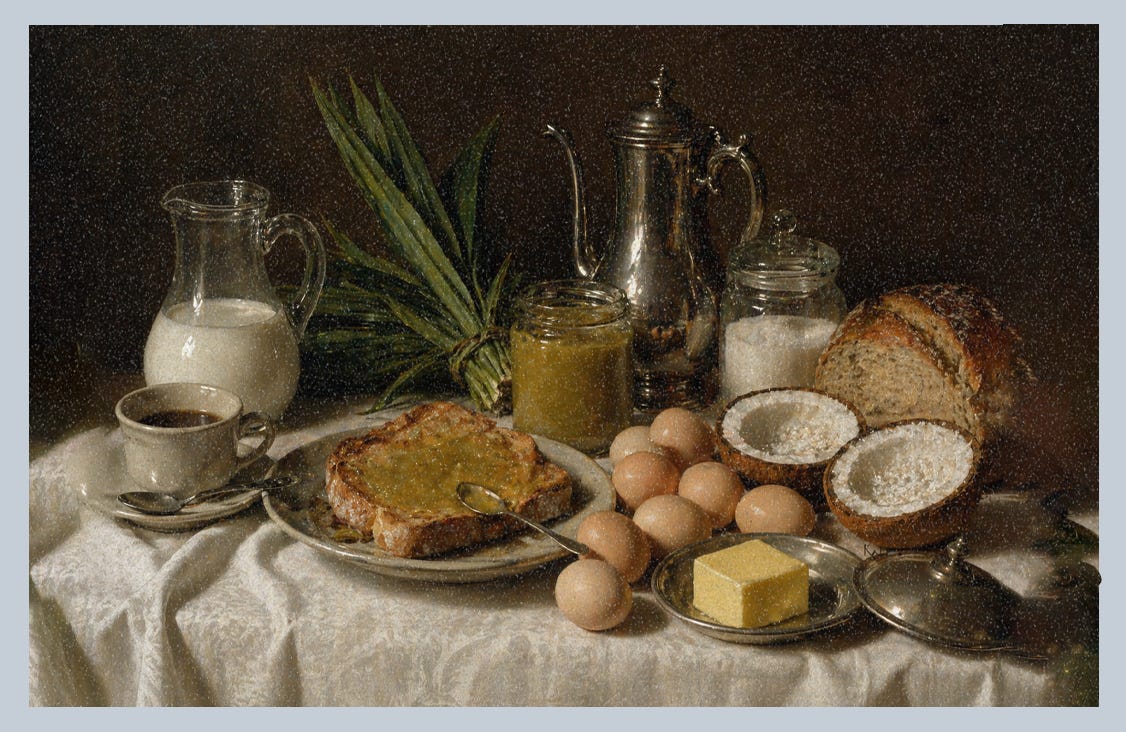
The word Kaya is derived from serikaya a sweet custard traditionally made by slowly cooking and stirring together: coconut milk, eggs, sugar and often pandan leaves for fragrance and slight green coloring. Kaya means rich in the Malay language and seri is derived from sanskrit which means splendid.
Variations of kaya can also be found in other parts of Southeast Asia. In Malaysia and Indonesia, it is known as serikaya. In Thailand and Cambodia, kaya is known as sangkhaya but it is prepared by steaming, not reduction.
Christopher Tan1 describes earlier versions of serikaya being slowly thickened in double enamel boilers into a sliceable texture to be served pressed with glutinous rice (pulot), on buttered toast or with apom. Nowadays, whilst still incorporated with kueh and used as a filling in buns, its most commonly known as a spread on Kaya Toast, a breakfast or tea time repast.
Origins
There is some debate in the origin story of kaya. Some sources suggest it is from Hainanese immigrants, some that it is a Eurasian creolised descendant of Portuguese egg custards adapted with local ingredients. Khir Johari in his book The Food of Singapore Malays2 points to an early mention of serikaya in Malay culinary manuscripts, like Cerita Kutai from 1620.
MALAY
In his 1608 work Ethiopia Oriental3 the Dominican monk João dos Santos recounts a story of a woman in Malacca attempting to poison the first Bishop of Malacca because he hindered her from certain illicit dealings, with a dish called serikaya. Dos Santos describes the dessert as a very common and popular delicacy made of eggs, sugar, and milk (likely coconut). This suggests the dish was already well-established and possibly indigenous to the region by the time the Portuguese arrived.
A 2024 paper Death by Dessert: Serikaya in 16th Century Melaka and Its Transmission to Portugal4 argues that serikaya was a Southeast Asian invention that the Portuguese stole and took back to Europe to create the similarly named Sericaia (first mentioned in Bluteau’s 1720 Portuguese dictionary) Its recipe is distinguished from serikaya by the inclusion of flour. The paper also cites Khir Johari ‘s arguments regarding the Malay based etymology of the word sans Portuguese roots and his reference to early Malay culinary manuscripts.
ARAB
Could custard making have been brought to the east by Arab traders? Long before the Portuguese arrived in Malacca, the Islamic world had already developed egg, milk and starch thickened desserts cooked gently to avoid curdling. Arab and Persian traders were present in India from at least the 8th century and in Southeast Asia from at least the 9th–10th centuries.
What distinguishes Arab custard based deserts like Muhallabiyya, Mahalabiya bi’l-Bayd, Qishta and Zalabiya from kaya is the absence of high egg-yolk ratios
and egg-sugar reductions cooked to a jam-like consistency. Those culinary techniques were hallmarks of Iberian and Portuguese cuisine not Middle Eastern.
PORTUGUESE
The Portuguese, once muslim ruled, may have inherited Arab culinary techniques for custard making but could also have inherited it from European culinary traditions where egg and milk dishes had been known since the Roman empire from the 1st century.
They did however intensify custards, transforming them with a massive use of egg yolks born of high use of egg whites used for starching clothes, in particular Nuns’ habits, and clarifying wine. Their custards were thicker, richer, spreadable, spoon-dense textures and sweeter. The Portuguese doce de ovos (egg jam) is much closer to kaya’s structure.
The era of Portuguese expansion is also one of involvement in sugar cane plantations and the trade for sugar. Sugar, once a luxury became cheaper, more easily available and more prevalent in use.
HAINANESE
Hainanese immigrants first arrived in Singapore in the 19th century, many of them worked as cooks on board British ships, in British homes, or in hotels run by Europeans. As competition for domestic employment increased and more British left Singapore in the early 20th century, many of these Hainanese immigrants began establishing their own businesses selling food in kopitiams.
Drawing from their experience working for Europeans, they echoed the western-style practise of eating fruit-based jams with bread or toast. If they weren;t the author of Kaya- they were certainly responsible for popularising Kaya Toast to its present day iconic status.
BRITISH
Whilst wheat based breads had already arrived in Asia via the silk road, Indian rotis, Chinese steamed buns and Portuguese Paos5, toast came later, most probably introduced by the British and popularised in colonial hotels and rest houses before their emergence in Hainanese kopitiams.
Conclusion
Whilst the story of the poisoned Malacca bishop gives credence to the existence of Serikaya predating Portuguese arrival, we don’t have conclusive evidence of the exact recipe used at that time to determine whether it resembles its modern day reiteration which shares the identity of intensified custards developed by the Portuguese. Or whether it was more like the custards brought earlier by Arab traders. A timeline of influence might perhaps look like this:
Islamic world (8th–12th c.)
The development of custard logic (milk + eggs, gentle heat), dispersed by Arab and Persian traders in Asia.
Medieval Europe (12th–14th c.)
By the 1500s, custard techniques are common culinary knowledge perhaps having existed as early as 1st century Rome
Portugal (15th–16th c.)
Intensifies yolk use into egg jams, influences already existing serikaya in Malacca either brought by earlier Arab traders or originated independently in the Nusantara region.
British Malaya (19th and 20th c.)
British Colonial popularisation of toast, emergence of Hainanese kopitiams popularising Kaya toast.
Malaysia (20th c. to present day)
Kaya toast is now standard fare not only in kopitiams but also in all kinds of cafes and hotel banquet rooms where breakfast is served. Bottled Kaya is a popular jarred or tinned pantry product found in most supermarkets. Whilst most popular as a spread, its also available as a filling in steamed and baked buns.
Like the history of many foods, origin stories aren’t only about their invention or introduction, it’s also about the modification along the way and its contemporary relevance fuelled by it’s popularisation by local entrepreneurs and it’s easy availability in the marketplace.