

Kebaya Stories 1
The Portuguese Eurasian Community's contribution to the evolution of the Kebaya

An Intangible Cultural Heritage
Recently, the Kebaya was included by UNESCO on its Representative List of the Intangible Cultural Heritage of Humanity as combined efforts of a few South East Asian countries involved in the nomination effort and the criteria required for its inclusion: knowledge, skills, traditions and practices of kebaya.
The Malaysian Ministry of Tourism, Arts & Culture notes that kebaya “represents and celebrates our rich shared history, promotes cross-cultural understanding, and continues to be present and actively practised by many communities across Southeast Asia.”
Etymology
The etymology of the word Kebaya is from the Portuguese 𝒄𝒂𝒃𝒂𝒚𝒂, a term for 'a tunic' or 'an over-gown'. ⁽The word was introduced into the Malay language during the Portuguese occupation of Melaka, which lasted from 1511 to 1641. The Portuguese appears to have borrowed it from the Arabic 𝒒𝒂𝒃𝒂' (قَبَاء), which in turn came from Persian 𝒒𝒂𝒃𝒂 (قبا) ('robe of honour'). Arabic caba, cabaya and cabaia, describing a long robe worn by the ruling class of India as well as the Middle East. 1 The term appeared in various European records from as early as 1553, when João de Barros described it as the attire of the Muslims.2
The term Kebaya in modern usage has become more descriptive of the ensemble or pairing of this robe or blouse, lace trimmed or embroidered, with a batik sarong. UNESCO describes Kebaya both as blouse: front-opening top often adorned with intricate embroidery and worn with fasteners such as brooches or buttons and also as a way of dressing. All these elements - batik sarong, way of dressing, lace trimmed, fastening with brooches - can be connected to European and Eurasian influence
A Way of Dressing
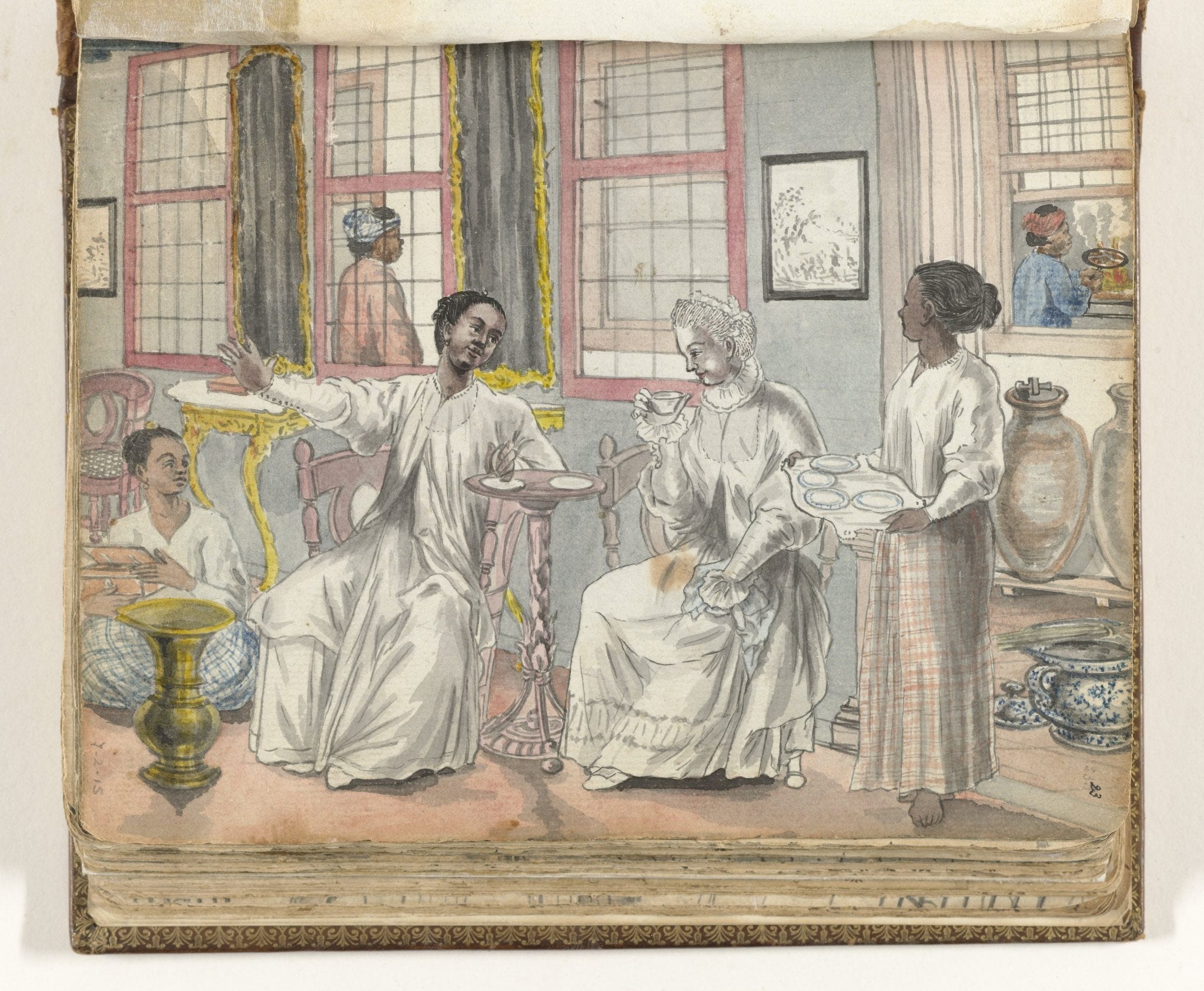
The four women featured in Jan Brandes’ watercolor pictured above wear variations of the kebaya, a loose upper garment which is a staple of women’s dress across the Indonesian archipelago. The watercolor depicts variations on this garment: From left, the gesturing darker-skinned woman, representing an Asian or Eurasian woman, wears a long kebaya with fitted sleeves, fastened at the top and spreading open over a loose, full skirt. The light-skinned European woman wears a similar kebaya, with a lace collar and cuffs, over a more structured gown. The dark-skinned serving woman, by contrast, wears a much simpler blouse, which falls only to her hips, over a wrapped skirt or sarong of red checks.3
In the painting The Castle of Batavia 1662 by Andries Beekman a Dutch merchant in European dress is shown walking with his Eurasian wife (most likely a Portuguese Eurasian) wearing a wrapped chintz skirt, (pictured below LHS ). In the middle a Mardijker and his Wife, Johan Nieuhof, 1682


The image on the right Smoking Enslaved Woman, also by Beekman shows a generic white upper garment worn by the serving woman appears throughout images of women in Batavia, especially servants and enslaved women. There was a 1750 regulation for supplying clothing to children and enslaved people in Batavia’s orphanage which include specific mention of white or plain shirts of guinea cloth.4
Indian Chintz & Batik Sarongs
Kebayas were initially worn as indicated above with Indian chintz, checks and stripes. Large quantities of Indian textiles from the Coromandel Coast of India were exported to Java, where they were referred to as serasah, kumutir or sembagi. The quantity of these textiles was substantially increased when the Portuguese who acquired Coromandel textiles in India mainly for re-export to Southeast Asia, where they could be bartered for spices and other forest products.5
These textiles would then became important sources of inspiration for traditional batik design from the North Coast of Java in terms of their colour schemes, designs and layouts. These multi-coloured long cottons, decorated with the chintz technique had these tumpal design at both ends a modern term for a saw-tooth design (a row of elongated triangles) that was used widely in Indian textiles. This design, is also known as pucuk rebung or bamboo shoots, and became an important feature of batik sarongs.6 Eventually, locally produced batiks would replace chintzes machine printed and imported from Europe.


Indian Chintz | Pucuk Rebung
Portuguese Influence on the Kebaya
Some historical accounts suggest that the kebaya emerged during the Majapahit era in the 14th century in Java and was adopted by Javanese royalty, The baju worn by noblewomen in the court of Banten in Java however were "so lightly executed that their embroidery does not hinder one from perceiving their naked bodies." By contrast, the Eurasian adoption of the baju panjang tended toward a more structured, covered silhouette. Later the kebaya gradually became a tighter, more form-fitting garment.7
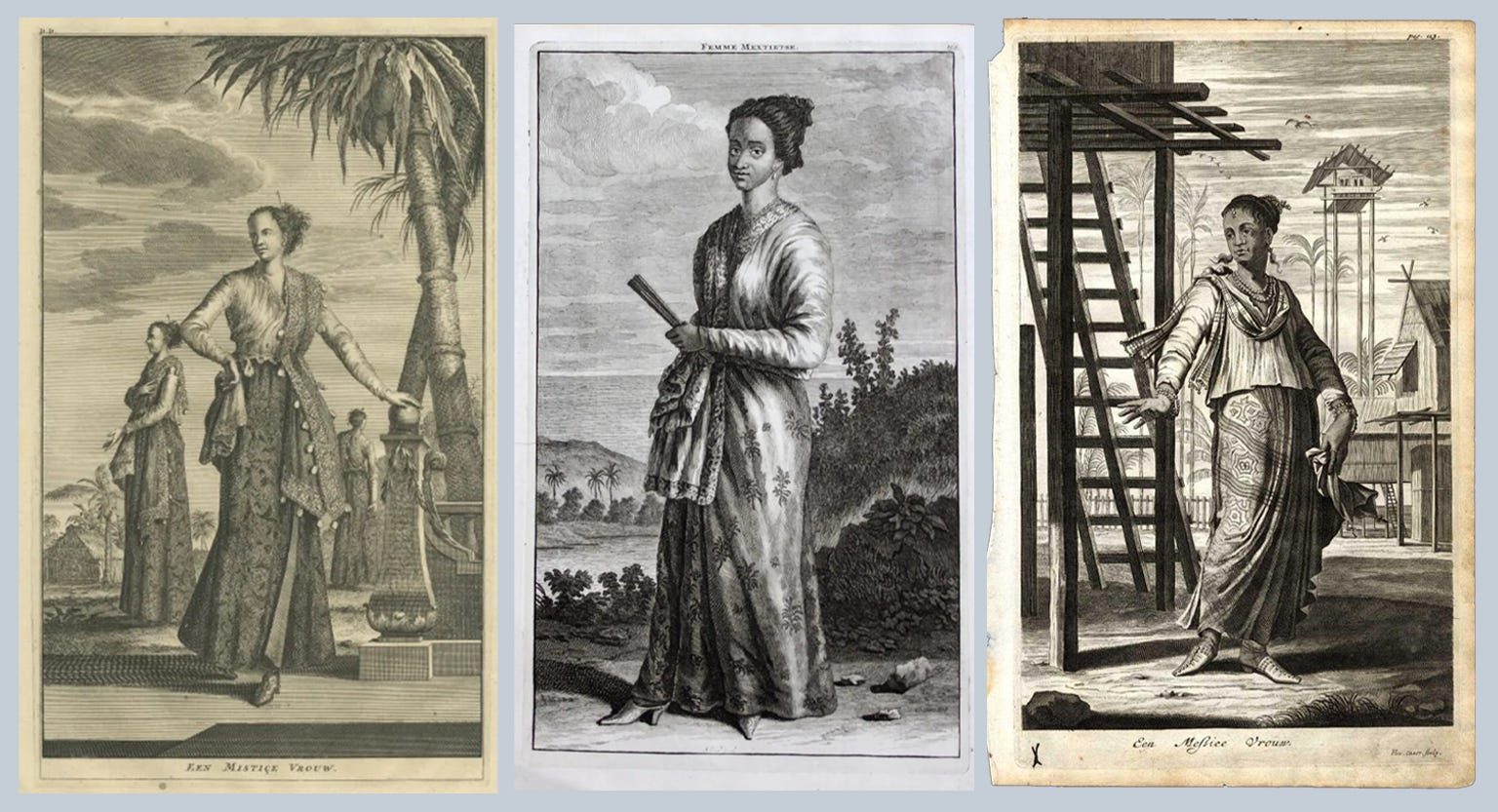
Mistice' Woman by Valentijn, 1726 | Mestizo Woman, Cornelis de Bruin | Mestizo Woman by Nieuhof (1744)
The following perspectives shift the focus from a purely Javanese or Arabic origin to one attributable to the Luso-Asian (Portuguese-Asian) maritime trade network, where constant movement of people, including wives, slaves, and servants, created a shared material culture where the cabaya became standard dress for Eurasian women in all Portuguese ports.
Historical Accounts
Peter Mundy (1630s): A British traveler who visited both Goa and Malacca. He explicitly noted that women in Malacca dressed in a style very similar to women in Goa, providing a contemporary observation of the shared fashion across these Portuguese hubs. He noted they wore a long, thin, white smock ( often identified as a precursor to the kebaya ) and a sarong-like cloth wrapped around their lower bodies, often covering their heads with a veil when going to church.8
João de Barros (1510): A Portuguese historian who provided one of the earliest descriptions of the cabaya in Goa. He described it as a long-sleeved garment used by “Moors” (Muslims) in those parts, which was then adopted and popularized by the Portuguese as they moved into Southeast Asia.
Manuel Godinho de Erédia (1613): A Bugis-Portuguese (born in Malacca) writer who suggested that merchants from Egypt and Arabia brought these garments to the region but his writings9 also link the spread of the garment directly to the maritime routes controlled by the Portuguese between India and Malacca.
Linguistic & Cultural Analysis
Denys Lombard: the French scholar noted that the term kebaya is a Portuguese loanword derived from the Arabic qaba and that the Portuguese acted as the primary linguistic and cultural conduit for the term and the garment style in the region.10
Yule & Burnell (Hobson-Jobson Dictionary, 1886): This landmark etymological work traces the cabaya as a surcoat or long tunic of muslin worn by upper classes in India (specifically Goa). It highlights that the Portuguese introduced the term to the Indian subcontinent before spreading it further east.11
Dressing Badly in the Ports by Peter Lee. Lee argues that the Eurasian communities—who were the mobile, “transnational” population of the time—were the most likely carriers of this hybrid fashion. He uses a description of Catharina Johana Koek in Malacca to illustrate how this “Goan style” had become the established elite Eurasian dress by the late 18th century.

He describes the cabaya as worn by men and women, including the women of the first Eurasian communities in the Portuguese colonies of Goa and Malacca, and the Spice Islands.12 In a recent 2025 podcast Peter Lee emphasizes that the evolution of the sarong kebaya is inextricably linked to mixed-race communities and the cross-cultural dynamics of port cities.
Kerosang


Peranakan Kerosang | Portuguese Filligree
Kerosang, means brooches, derived from the Portuguese word "coração," which translates to heart. The word originates from the days when Portuguese men gifted heart-shaped pendants or coração made of silver filigree work, to their fiancées and wives as a symbol of their love.
The coração was popular in Portuguese Goa and Ceylon, and was introduced to the British Straits Settlements to become the top pin in the set of three used to fasten the kebaya blouse. This top pin was called the ibu kerosang or 'mother kerosang' in Malay, while the two smaller brooches were referred to as the anak kerosang or child kerosang. According to exhibits at the Eurasian Heritage Gallery in Singapore, local craftsmen added Chinese, Malay, Indian and Sinhalese influences, resulting in a very multicultural flavour to the jewellery that eventually lost its original heart shape.13
Evolution of the Kebaya under Dutch Influence
While the base garment may have come from Goa, the later white lace kebaya (Kebaya Noni) was a specific evolution within the Eurasian (Indo) community in the Dutch East Indies, blending these earlier Luso-Asian foundations with European lace.


20th Century Kebaya in the Portuguese Eurasian Community
Whilst some members of the Malacca Portuguese Eurasian community do still wear the kebaya, the Eurasian community has largely moved away from wearing this more native style to western style dress. At the tail end of the Dutch colonial era more Dutch women were coming out east with the shorter voyage via the Suez canal thus reducing the occurrence of Dutch men marrying locals.
The British colonial era that followed, continued to discourage intermarriage introducing more restrictions for Eurasians to enter civil service and private clubs contributing to the community’s inclination to present in a more western manner.
With the introduction of Portuguese folk dancing in the 1950’s14 the Malacca Portuguese Eurasian community has also leaned more into Portuguese folk dress as an expression of their cultural identity. All these influences have decoupled the Eurasian communities long and important history of involvement in the evolution of the Kebaya.
𝑆𝑎𝑟𝑜𝑛𝑔 𝐾𝑒𝑏𝑎𝑦𝑎: 𝑃𝑒𝑟𝑎𝑛𝑎𝑘𝑎𝑛 𝐹𝑎𝑠ℎ𝑖𝑜𝑛 𝑖𝑛 𝑎𝑛 𝐼𝑛𝑡𝑒𝑟𝑐𝑜𝑛𝑛𝑒𝑐𝑡𝑒𝑑 𝑊𝑜𝑟𝑙𝑑, 1500-1950. Singapore: Asian Civilisation Museum. Peter Lee
Dalgado, Sebastião Rodolfo (1988). 𝑃𝑜𝑟𝑡𝑢𝑔𝑢𝑒𝑠𝑒 𝑉𝑜𝑐𝑎𝑏𝑙𝑒𝑠 𝑖𝑛 𝐴𝑠𝑖𝑎𝑡𝑖𝑐 𝐿𝑎𝑛𝑔𝑢𝑎𝑔𝑒𝑠: 𝐹𝑟𝑜𝑚 𝑡ℎ𝑒 𝑃𝑜𝑟𝑡𝑢𝑔𝑢𝑒𝑠𝑒 𝑂𝑟𝑖𝑔𝑖𝑛𝑎𝑙 𝑜𝑓 𝑀𝑜𝑛𝑠𝑖𝑔𝑛𝑜𝑟 𝑆𝑒𝑏𝑎𝑠𝑡𝑖𝑎̃𝑜 𝑅𝑜𝑑𝑜𝑙𝑓𝑜 𝐷𝑎𝑙𝑔𝑎𝑑𝑜. 𝐼𝑛𝑑𝑖𝑎: 𝐴𝑠𝑖𝑎𝑛 𝐸𝑑𝑢𝑐𝑎𝑡𝑖𝑜𝑛𝑎𝑙 𝑆𝑒𝑟𝑣𝑖𝑐𝑒𝑠.
Miki Sugiura, “The Economies of Slave Clothing in the Eighteenth-Century Dutch Cape Colony,” in Dressing Global Bodies: The Political Power of Dress in World History
Description of Malaca Eredia
Lombard, Denys. Le Carrefour Javanais: Essai d’histoire globale