


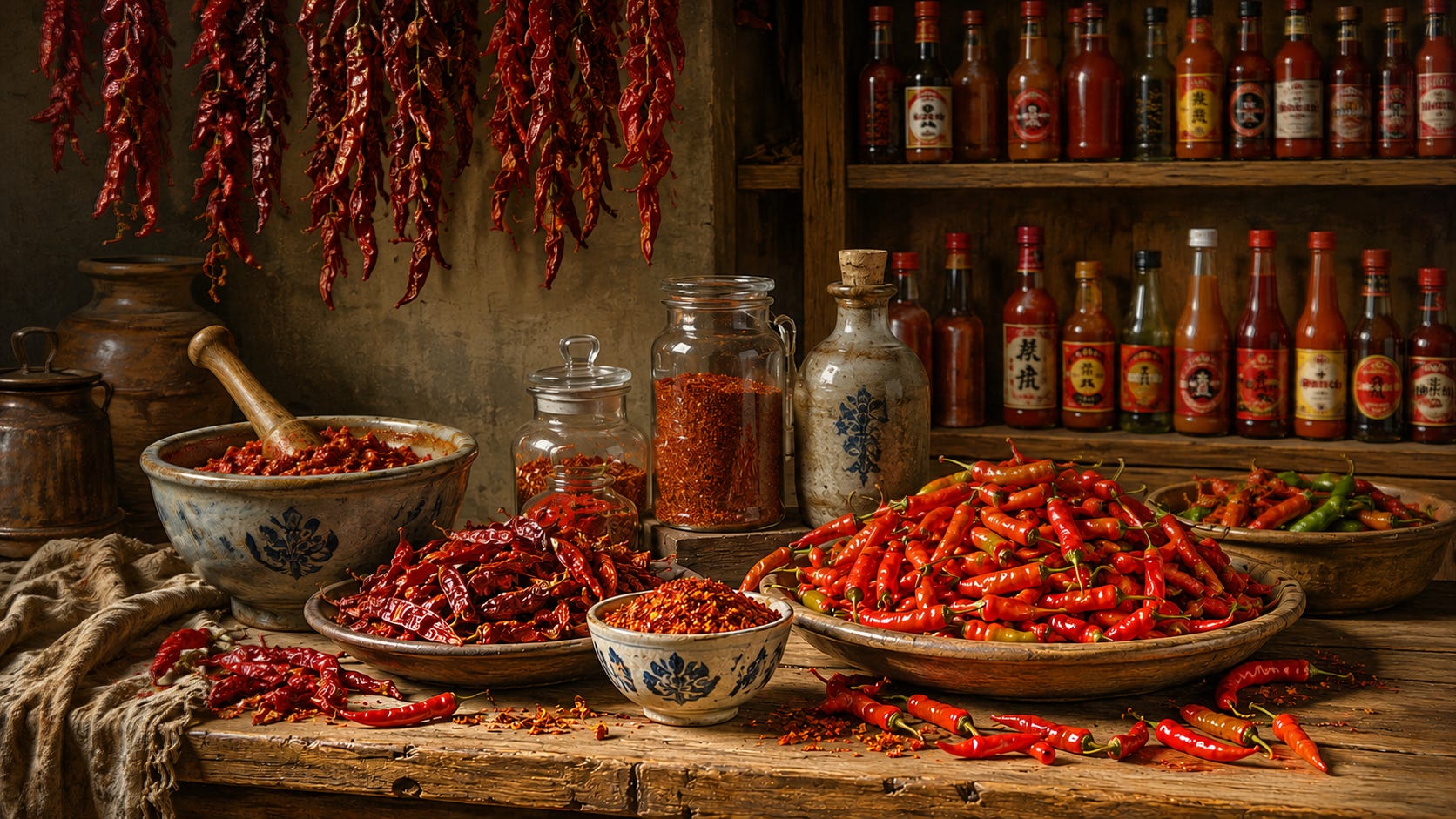
South American Origins
Botanically, the genus Capsicum belongs to the Solanaceae, or nightshade, family, and its ancestral lineage traces back to the Andean slopes of modern-day Peru and Bolivia. The wild progenitors produced small, intensely red fruits adapted for dispersal by birds, which lack the TRPV1 pain receptors that make mammals recoil from it’s active ingredient Capsaicin. That original dispersal mechanism. might explain why humans would eventually seek out this discomfort accompanied by a stimulant rush.
The story of one of history’s most consequential agricultural domestications begins with the farmers of central Mexico.1 2 Archaeological evidence from the Tehuacan Valley and the Ocampo Caves places the earliest harvesting as far back as nine thousand years ago, with deliberate cultivation and seed selection beginning roughly six thousand years ago. Simultaneously, distinct species were domesticated in separate ecological zones: C. frutescens in the Caribbean, C. baccatum in Bolivia, C. chinense in northern Amazonia, and C. pubescens in the southern Andes. Microfossil starch grains on milling stones found in southwestern Ecuador confirm that domesticated varieties were integrated into complex agricultural systems alongside maize and beans by at least 6,100 years ago.3
Within indigenous societies of Mesoamerica, chilies were also medicines, ritual objects, and practical household tools. Aztec cooks prepared what Spanish conquistadors described as ‘chilmolli,’ elaborate chili sauces served with meals, including chocolate and sweets. Healers used them as analgesics and fumigants. Mayan practitioners burned chili, ash mixtures to cleanse homes and deter insects, prizing their antimicrobial properties. The plant held spiritual meaning: green chilies associated with the Rain God, representing water, red chilies symbolised heat and vital energy. Warriors hurled gourds packed with ground chili and ash to incapacitate opponents with choking smoke. By the time European ships arrived in the Caribbean in 1492, the chili pepper was a sophisticated domestic crop with a deep social biography.
How the Chili Came to Asia
The vehicle for the chili’s journey across the world was the Columbian Exchange, a biological and cultural transfer that followed European maritime expansion after 1492. Christopher Columbus, having failed to find the black peppercorns he had been commissioned to source for the Spanish crown, encountered Capsicum in the Caribbean and named it ‘pimiento’ to suggest it had the commercial value of the prized Asian spice. The misidentification stuck; the word ‘pepper’ remains attached to the chili in dozens of languages to this day and the chilli was carried back to Europe and then onward through trading networks across the world.4
Portugal was the primary engine of the chili’s global diffusion into Asia. Having established a chain of trading posts linking Lisbon to the Indian Ocean, Afonso de Albuquerque’s capture of Goa in 1510, established it as a key hub where at least three different chili varieties were cultivated. From Goa, Portuguese vessels carried the plant to Malacca, Sri Lanka, and Macau, distributing it through trade routes built to carry black pepper, nutmeg, and cloves back to Europe.
Spain established a parallel route across the Pacific. From 1565 onward, the Manila Galleon trade carried goods, people, and seeds directly from Acapulco to Manila, from where chilies spread into coastal China and across the Pacific Islands. Overland routes played an equally important but often overlooked role: Ottoman forces, captured chili seeds and introduced them to the Middle East and along the Silk Road into Central Asia. This explains how inland provinces of Sichuan and Hunan adopted chilies so early, despite the earliest known Chinese written record of the fruit appearing only in a late Ming text dated 1591.5 6
In Asia the chili was not so much transplanted as absorbed into existing spice traditions, fermentation practices, and cooking philosophies. That process of creative localisation making the chili feel almost native in cultures separated from its origin by both ocean and time.
Policy, Trade, and the Economics of Adoption
During the seventeenth and eighteenth centuries, the Dutch East India Company and the British East India Company established aggressive monopolies over traditional spices: black pepper, nutmeg, and cloves. By artificially inflating prices for European markets and restricting local supply, these charter corporations created a profound scarcity of affordable seasoning across Asia. Colonial authorities deliberately avoided commercialising the chili, dismissing it as a low-status ‘weed’ or ‘poor man’s pepper.’ That dismissal proved to be the plant’s greatest commercial advantage.7 8
In British India, administrators converted food-producing land into monocultures of cotton, tea, indigo, and opium, triggering catastrophic famines well documented in colonial history. This left rural populations with diets narrowed to bland starches. Because chilies were self-pollinating, rapid to mature, and exempt from the mercantilist tax structures imposed on black pepper plantations, marginalised farmers across India and Southeast Asia could grow them in domestic gardens and on degraded soils that could not support more delicate crops.
Chillies stimulate the salivary glands, increases gastric motility, and makes unappetising staples more palatable. The high vitamin C content of fresh and dried chilies provided a nutritional safeguard against scurvy, it’s antimicrobial properties, relevant in tropical climates without refrigeration, also allowed households to preserve food longer.
In China, agricultural systems in the southwest and centre encouraged experimentation with crops suited to varied climates and poor soils, and chilies fitted this requirement perfectly. By the eighteenth century, Sichuan and Hunan had developed what food scholars describe as ma-la cuisine, a marriage of numbing Sichuan pepper and fiery chili heat that is now one of the most globally influential flavour profiles in the food world.6
How Asia Made the Chili Its Own
India
No country has more thoroughly absorbed the chili into its culinary identity than India where it is incorporated into masalas, acars and Ayurvedic medical practice as a stimulant and digestive aid. Today India is the world’s largest producer of dried chili peppers, accounting for 48 percent of global production, while consuming 70 percent domestically. The chili appears fresh, dried, and powdered in virtually every regional kitchen, from Kashmiri mirch, valued for its colour to the incendiary Bhut Jolokia of the northeast. In the south, Andhra Pradesh alone produces 44 percent of India’s national chili yield.15
Southeast Asia
In Malaysia and Singapore, the chili became the foundation of sambal, the most culturally embedded condiment in the region served with nasi lemak, grilled fish, and fried foods. The bird’s eye chili, known locally as cabe rawit in Indonesia and chilli padi in Malaysia, has become a defining ingredient of regional identity, its small size inversely proportional to its cultural significance.10 11
In Thailand, chilies displaced native peppercorns in the essential pastes that underpin it’s native cuisine. Pounded with garlic, shallots, lemongrass, shrimp paste, and lime, chilies form the structural backbone of dishes from kaeng tai pla to the fiery curries of the southern provinces. In the Philippines, not only the fruit but the leaves of the chili plant became part of the cuisine, used as a green vegetable in tinola chicken soup.
China and East Asia
Sichuan cuisine is built around the combination of dried chili and Sichuan peppercorn. Hunan cuisine, arguably even hotter, uses fresh and fermented chilies as primary seasoning agents. Mao Zedong, a Hunanese, famously declared that the willingness to eat chilies was a prerequisite for revolutionary spirit.6
In Korea, the chili arrived during the Japanese invasions of 1592 to 1598, first regarded with suspicion as a ‘southern barbarian pepper.’ By the eighteenth century it had become indispensable, not as a table condiment but as fermentation agent. Gochugaru, dried and ground Korean chili flakes, provides the characteristic colour, heat, and savory depth of kimchi and the fermented paste gochujang, both now Korean culinary exports recognised around the world. In spice blends such as shichimi togarashi or in the fermented condiment yuzu kosho, its usage reflects restraint and balance more than heat.12 23
Europe
When Columbus brought chili samples back to Spain in 1493, European reception was shaped by two filters: humoral theory and economic aspiration. The prevailing medical philosophy classified Capsicum as ‘excessively dry and hot,’ potentially dangerous to bodily balance. To mitigate this perceived risk, European cooks pickled chilies in vinegar or candied them with sugar, to neutralise the heat. At the same time, because chilies were easy and inexpensive to grow compared to taxed and monopolised Asian pepper, they were swiftly labelled ‘poor people’s pepper’ and moved from aristocratic botanical gardens into peasant kitchens.13
The most consequential European transformation occurred in Ottoman-controlled Hungary. By the late eighteenth century, Hungarian peasants were grinding dried chili into paprika, a spice that began as folk medicine and cheap seasoning before ascending to the tables of the nobility eventually becoming a defining pillar of national identity. Elsewhere in southern Europe, chilies became embedded in regional specialties such as pasta all’arrabbiata and the Calabrian peperoncino.
In Britain, the chili’s journey came full circle when chicken tikka masala, and curries rich with ground chili introudced by Indian immigrants, was declared by a government minister in 2001 to be ‘a true British national dish,’ an accidental but accurate summary of how completely the Columbian Exchange and colonial history had reshaped European identity.
USA
In the United States, wild chili relatives grew in the American Southwest long before European arrival, but domesticated Mexican cultivars entered via Spanish conquest in the sixteenth and seventeenth centuries, and the transatlantic slave trade, which brought West African and Caribbean populations familiar with chilies to the southern United States. These communities established chili as a foundational ingredient in American soul food and Southern cooking.
The Scoville Heat Unit scale, developed by pharmacist Wilbur Scoville in 1912, gave American food culture a vocabulary for measuring heat, inadvertently providing the infrastructure for the competitive extreme-heat subculture that would emerge a century later. Now chili culture is mainstream with hot sauces and salsa having outsold ketchup since the early 1990s. Breeders have produced the Carolina Reaper and the Pepper X, the latter reaching 2.69 million Scoville units. Hatch in New Mexico markets itself as the ‘chili capital of the world’ and hosts annual festivals of significant regional economic weight.
The Business of Heat
The chili pepper is now a global commodity whose economic footprint spans agriculture, food processing, pharmaceuticals, cosmetics, and emerging biotechnology. The chili pepper market valued at approximately USD 10.88 billion in 2025 is projected to reach USD 17.06 billion by 2032, growing at a compound annual rate of 6.63 percent, driven by rising demand for bold flavours, functional ingredients, and the increasing influence of younger consumer demographics with an appetite for complex heat profiles.14 Sean Evans' Hot Ones is one of the most successful shows on YouTube.
The chili value chain peaks not where the pepper is grown, but where it is processed, branded, and sold. Q4 2025 pricing data illustrates the point: a metric tonne of chili peppers fetched around USD 1,574 in China, USD 1,766 in India, USD 2,310 in Malaysia, and USD 3,389 in the United States. The highest prices sit at the downstream end of the chain, where processing, branding, and distribution multiply the value of the raw fruit many times over.16
In Asia, the commercial stakes are enormous and run from field to factory. India exported over 500,000 metric tonnes of chilies in 2025, maintaining its position as the world’s largest exporter of dried red chili, with shipments worth approximately USD 1.34 billion. Chili represents more than 30 percent of India’s total spice export value by both volume and earnings. Andhra Pradesh alone, producing 44 percent of national output, has built an agri-economy around high-value varieties such as Teja and Byadgi sought by buyers across the Middle East, Southeast Asia, Europe, and North America.15
China commands the largest raw production volumes in the world and also hosts major chili sauce and condiment brands whose reach extends globally multiplying farm-gate value into branded consumer products. South Korea adds another processing tier through fermentation with chili embedded in condiment manufacturing commanding premium pricing world wide. Japan, though a more restrained chili consumer, when included in East Asia adds up to one of the strongest downstream value zones in the global chili economy.17 19
In Southeast Asia, Malaysia and Singapore function as a regional sauce-manufacturing hub with halal sauce producers serving domestic markets and a broader Muslim consumer base across the region and the Middle East. India, meanwhile, operates as a major spice-processing centre: firms such as MDH Spices and Everest Food Products capture value through grinding, blending, and packaging that transforms bulk dried chili into the masala blends bought by consumers in diaspora markets worldwide.19
Iconic Sauces
Sambal, predates the chili’s arrival in Southeast Asia. Ancient Javanese records from the tenth century reference a spicy paste made from long pepper and ginger, ground using stone mortars that chillies transformed into a fiery Spice Base that became a foundation of Southeast Asian culinary style and a condiment industry exported to diaspora communities globally.22
Sriracha’s original recipe was developed in the 1930s by a Thai homemaker, Thanom Chakkapak in Si Racha, Chonburi, who blended garlic, vinegar, and chili to serve with seafood. In 1980, Vietnamese refugee David Tran created a thicker, jalapeño-based adaptation in Los Angeles under his company Huy Fong Foods, producing the iconic hot sauce that has became a fixture of American and global food culture from Singapore to Stockholm.20
Tabasco, created in 1868 by former banker Edmund McIlhenny on Avery Island, Louisiana, is arguably the world’s oldest surviving branded chili product. McIlhenny planted Capsicum frutescens seeds from the Tabasco region of Mexico, aged the mashed pepper mash with local salt, blended it with wine vinegar and bottled it in repurposed cologne bottles. Patented in 1870, the brand is now distributed to over 195 countries.21
Gochujang, Korea’s fermented chili paste, was developed during the Joseon Dynasty following the late-sixteenth-century introduction of chilies to the peninsula, by combining ground red chili powder with fermented soybeans and glutinous rice, then aged in jangdok earthenware. Driven partly by Korean popular culture and partly by the growing interest of chefs and food manufacturers in umami-rich ingredients it now appears in fast-food chains, supermarket ranges, and restaurant menus across Europe, North America, and Australia.23
Premium Brands
In Europe and the United States, the chili’s economic power is concentrated not in production but in branding, distribution, and retail. Companies such as McCormick, Kraft Heinz, Campbell Soup, Unilever, and Conagra are among the dominant players in a hot sauce and seasoning market worth tens of billions. Chili-infused craft beers are now a recognised style on specialist rating platforms. Snack companies are releasing superhot products targeting a ‘swicy’ (sweet and spicy) consumer trend.
The United Kingdom and the Netherlands function as major import, blending, and distribution hubs for the European spice trade, while Spain’s pimentón de la Vera, Hungary’s paprika, and Italy’s peperoncino each carry Protected Designation of Origin status, attaching geographic identity to price premiums and export value.18
New Frontiers
A new chapter in the chili’s story is being written not in kitchens but in laboratories. Capsaicin, has attracted intense pharmacological research interest because of its wide effects across multiple human physiological systems. A review published in the Journal of Pharmacy and Pharmacology in April 2025 summarised evidence-based applications ranging from pain management to cardiovascular benefit, weight loss support, and potential anti-cancer properties. Capsaicin’s high oral bioavailability and effective skin absorption make it a viable candidate for topical therapies, and it is already approved in high-concentration patch form for neuropathic pain management in several major markets.24
It’s been shown to inhibit COX-2 enzyme activity and downregulate iNOS protein, reducing inflammatory cytokines implicated in cancer risk. It interacts with critical signalling pathways including NF-kB and EGFR, influencing gene expression governing cancer cell survival, growth arrest, and angiogenesis. A systematic review of two decades of global capsaicin research, published in Frontiers in Oncology, confirm that capsaicin science has become a global research enterprise. Clinical trials remain limited, but the chemo-preventive potential of capsaicin is now a mainstream focus of oncological pharmacology.25
Pain medicine is perhaps the most clinically advanced frontier. High-concentration capsaicin patches are now supported by large cohort studies and international guidelines for treating neuropathic pain secondary to cancer treatments. Research published in Current Opinion in Supportive and Palliative Care in December 2024 found clear support for capsaicin’s role in managing chronic cancer pain in survivor populations, a growing area of unmet clinical need as oncological survival rates improve.26
Research programmes, including work by the World Vegetable Center in Taiwan and Nigeria, have produced new hybrid pepper varieties with resistance to Tomato mosaic virus, Chili veinal mottle virus, Potato virus Y, phytophthora blight, and bacterial spot. These disease-resistant varieties reduce pesticide dependence and improve smallholder profitability in tropical farming systems.
At the same time, extreme varieties such as the ghost pepper, the Carolina Reaper, and the Pepper X continue to drive a niche premium market oriented around novelty and competitive heat. Consumer research by McCormick suggests Southeast Asian markets are identifying niche demand areas: Indonesia favours hot-and-sweet, Vietnam leans toward hot-and-sour, while Thai consumers are seeking stronger heat experiences.27 28
An early-stage commercial application for Capsaicin is also being explored for sustainable agriculture, where its antimicrobial and pest-repellent properties offer potential as a crop protection agent, reducing chemical inputs.29 Space, too, has become a frontier. In 2021, a dwarfed variety of the Hatch chili cultivar became the first fruiting crop ever grown and harvested aboard the International Space Station, as part of NASA’s Plant Habitat-04 experiment. 30
Conclusion
Today the chili is simultaneously a foundation of some of the world’s most complex culinary traditions, the object of new culinary fads and pharmaceutical research. It is the basis of a USD 10.88 billion market projected to reach USD 17.06 billion by 2032. Born in the Americas, matured in Asia, reinvented in Europe and the United States, the chili pepper belongs to no one and to everyone.
