


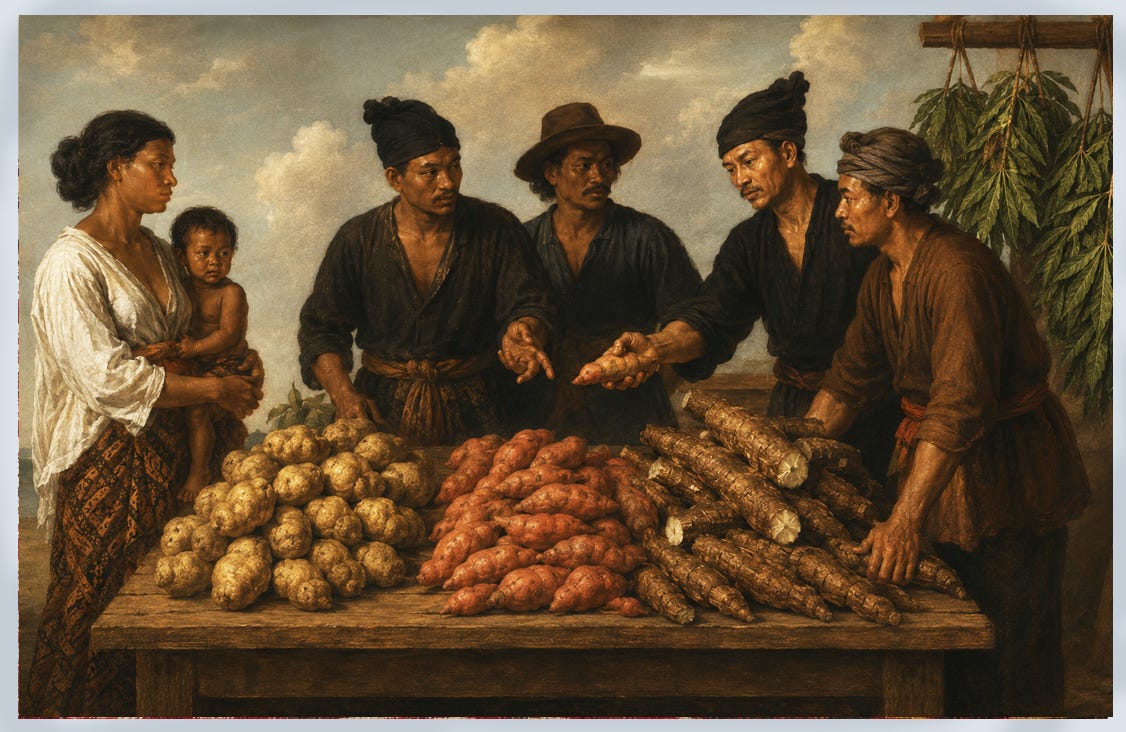
It would be hard to percieve European culinary traditions without potatoes: meat and potato pies, sausage and mash, fish & chips, gratin dauphinois, gnocchi, or potato salad. In the US sweet potatoes are part of the tradition of thanksgiving and central to Southern cuisine. Cassava or tapioca flour is endemic in gluten free baking and industrial sauce thickening in place of cornstarch. But all these tubers only found their way to Europe at the tail end of the 16th century, after centuries of use in Tropical America where their wild ancestors were native
After adapting to cultivation and culinary adaptation in Europe these tubers headed east begining another wave of the same. Hard to imagine now a samosa or a curry without potatoes. Locals would be pressed to believe their Mee Rebus thickened with sweet potatoes or their kuehs made from tapioca flour originated from anywhere else than their own native soil. Across the geographic and human diversity found across these continents with Mountain regions, dry zones, marginal soils, potatoes, sweet potatoes and tapioca all found a home adapting to a variety of localised farming and culinary traditions staying the course of centuries.
Potatoes delivered calorie rich harvests, adapting well to temperate farming. combining bulk calories with a relatively short growing cycle. Sweet potatoes tolerated poor soils and heat and offered flexibility, with both edible leaves and roots. Cassava brought endurance, especially where many other crops failed, resilient through drought, hot and dry conditions giving farmers a crop that could be turned into food or processed into industrial starch.
We look now at the origin story of each of these tubers,and how they have found their way into the economic and culinary heart of Asia.
Potatoes
Potatoes, Solanum tuberosum, the third most important crop grown for direct human consumption, were domesticated between 8,000 and 10,000 years ago from a wild species native to the Andes Mountains in southern Peru. Researchers sequenced the genetic code, of a spectrum of potatoes native to South America, identifying a rainbow of potatoes on the continent.1
Potatoes don’t breed true from seeds. In the wild they must be fertile to disperse seeds making starch storage organs for the plant to grow from year to year. Cultivated species nowadays are grown from tubers that the Andean people through selection, developed larger tubers that were easier to eat.
Potatoes were brought by Spanish conquistadors to Europe in the sixteenth century. Initially popular in Spain because they provided cheap sustenance soon came into demand throughout the continent as an easy to grow, nutritious food crop. The first potatoes seen in Europe had tiny tubers the size of peas or cherries because the formation of tubers was regulated by the length of day. Being close to the equator, the Andes experienced days and nights of equal length. Tuberisation, the development of larger tubers during long European summer days came later with mutations and adaptations in Europe.2
Potatoes then headed to Asia via Spanish and Portuguese maritime routes in the late 16th century, with the Philippines among the earliest documented Asian destinations. In India, the Portuguese introduced the potato to the , Goa and the Malabar region on the western coast but it remained limited in scope, probably because it was a relatively unfamiliar food and local farming systems had not yet fully reorganised around it.
The 19th century is when potato acquired momentum when the British campaigned to grow more of these food plants providing incentives like seeds and transit tax exemptions to farmers. An emerging scene of British-style hotels and restaurants, where the middle classes could try out unfamiliar dishes introduced the potato into domestic Indian kitchens. Potatoes then were being grown across Bengal and the hills of north India. 3
Potatoes became especially important in South Asia once farming, storage, and marketing systems caught up with demand. In India, state-backed cold storage, important because the tuber is highly perishable after harvest, helped turn potato from a seasonal glut crop into a year-round commodity, Once growers could store and release potatoes strategically, the crop became much more useful to markets, traders, and cooks.
Potatoes reached China most likely between 1570 and 1600 via Portuguese and Spanish traders along China’s southern coast. The earliest documented reference to potatoes appear in provincial gazetteers from Fujian and Guangdong provinces in the early 17th century. Potatoes remained for two centuries, a curiosity, grown in small quantities, its real expansion came during the Qing Dynasty, when population pressure pushed farming into marginal highland areas where rice couldn’t grow. Potatoes thrived in these cool, mountainous regions, carving a permanent place in China’s food system.
China’s potato production accelerated dramatically in the 20th century.when it spread into the interior provinces of Yunnan, Guizhou, Sichuan, Gansu, and Inner Mongolia. Where other staple crops struggled in these high-altitude plateaus and semi-arid regions, the potato thrived and by the 1990s it had surged to first place globally where it has remained to this day as government policy increasingly promoted the crop.4
In Southeast Asia, unsuitable for cultivation in the tropical lowlands, potatoes are grown mainly in cool highland belts in Indonesia, Cameron Highlands in Malaysia, Vietnam’s Red River Delta and the Philippines’ Northern Luzon highlands, with local demand requiring imports valued at roughly USD 450 million a year, from China, India, Pakistan, Bangladesh.
CULINARY APPLICATIONS
India
Aloo Gobi: A classic North Indian curried vegetarian dish made with potatoes and cauliflower.
Aloo Paratha: Unleavened flatbread stuffed with a spiced, mashed potato filling, typically eaten for breakfast with yogurt or pickles.
Vada Pav: A beloved Mumbai street food featuring a deep-fried, spiced potato burger sandwiched inside a soft bread roll or pav
Japan
Nikujaga: A comforting, homestyle stew of thinly sliced meat beef or pork, potatoes, and onions simmered in a sweet soy sauce broth.
Korokke: Japanese-style deep-fried potato croquettes, often mixed with minced meat and coated in crispy panko breadcrumbs.
Potesara: A creamy Japanese-style potato salad featuring mashed potato chunks, cucumbers, carrots, sliced ham, mixed with Japanese mayonnaise.
Malaysia & Singapore
Chicken Chop: A descendant of a variety of dishes from Colonial Era Cuisine often served with a side of fried or mashed potatoes .
Chicken Curry with potatoes, served with roti, or rice, is classic all day fare in kopitiams and home tables across all communities in Malaysia.
Curry Puff : A Portuguese influenced fried snack, similar to the Empada, with a curried potato and meat filling is ubiquitous as a teatime treat.
In Eurasian homes potato is prevalent in Devil Curry, Stews, Chicken Pies, Shepherds Pies and Pang Susi buns. In Peranakan homes Pongteh is a braised chicken or pork stew with potatoes in a soy sauce, fermented soybean paste and palm sugar gravy
Vietnam
Thịt Kho Khoai Tây: A homestyle dish of pork belly and potato chunks braised together in a sweet-savory coconut water and fish sauce reduction.
Cà Ri Gà A Vietnamese variation of Chicken Curry featuring chicken, carrots, and sweet or regular potatoes served with a baguette.
Canh Khoai Tây Sườn Heo: A clear, comforting everyday soup made by simmering pork ribs with large chunks of potatoes and carrots.
Thailand
Massaman Curry A Thai variation of Chicken Curry, with meat, peanuts, and large chunks of potato.
Man Tord A popular street food of potato wedges coated in a batter of rice flour, grated coconut, and sesame seeds, then deep-fried until crunchy.
Kai Pa-Lo with Potatoes: A localized variation of the five-spice egg and pork belly stew, with potatoes to soak up the sweet and savoury soy-based broth.
Indonesia
Perkedel Kentang: Very similar to the Malaysian Bergedil, are derived from Dutch rissoles that combine mashed potato with minced beef or chicken,
Sambal Goreng Kentang Ati: A staple festive dish of diced potatoes and beef liver fried together in a rich, spicy coconut milk and chili sauce.
Kentang Mustofa: A snack of matchstick-cut potatoes fried until ultra-crispy, then coated in a sweet, spicy, and tangy chili glaze.
Philippines
Chicken or Pork Adobo While traditional adobo focuses strictly on meat, many Filipino households add cubed potatoes to stretch the dish.
Menudo: A festive, tomato-based stew made with diced pork, pork liver, raisins, chickpeas, carrots, and potatoes cut into cubes.
Afritada: Spanish-influenced stew featuring chicken or pork simmered in a savory tomato sauce with bell peppers, green peas, and potato chunks.
Sweet Potatoes
Sweet potato, Ipomoea batatas, is not closely related to the common potato despite sharing a name and a continent. Its wild ancestor grows along the forest margins between present-day Mexico and Venezuela, and genetic and paleoethnobotanical evidence points to two independent events: one in Central America and one in the northwestern Andean foothills, with the oldest carbonised remains from Peru’s Chilca Canyon dated to around 8,000 BCE. By 2500 BCE, cultivation had spread across much of tropical America, well before any European contact. Carbonised tuber fragments from the Cook Islands have been radiocarbon-dated to around 1000–1100 CE. Genetic analysis of herbarium specimens point to Polynesian seafarers made direct contact with the South American coast and carried the plant home, making the sweet potato a pre-colonial traveller in its own right.5
Columbus brought the plant to Spain after 1492, where it initially carried the name batata, the same word applied later, confusingly, to the common potato. Portuguese mariners then carried it along what scholars now call the batata line — south to Africa, east to India, and onward to Southeast Asia and the East Indies. A parallel camote line ran directly across the Pacific, carried by Spanish galleons from Acapulco to Manila as part of the silver trade.
From Luzon it reached China’s southern coast: in 1594. During a period of flooding and failed rice harvests in Fujian province, a merchant named Chen Zhenlong smuggled vine cuttings back from the Philippines, and his son persuaded the provincial governor to distribute the plant as emergency relief.6
Japan received the crop via the Ryukyu Kingdom, which obtained it from Fujian around 1605. It remained a novelty in Satsuma domain until the Great Kyōhō Famine of 1732, when scholar Aoki Konyō, celebrated as “Professor Sweet Potato” developed cold-tolerant varieties that could be cultivated in central and northern Japan.7
The consequences of the sweet potato’s spread through China were substantial. Historians at Fudan University note that China’s population, estimated at around 20–50 million in the early Qing period, reached 313 million by 1793, a trajectory that would have been impossible on rice and wheat alone. The sweet potato’s capacity to grow on barren hillsides, without irrigation, made marginal highland terrain newly productive, driving a wave of internal migration that reconfigured entire provinces. Qing emperors from the Kangxi through Qianlong reigns actively promoted its cultivation as policy.
Across Southeast Asia, the sweet potato occupies a more modest but durable place: a subsistence crop on poor soils, a thickener in noodle sauces, a base for kuih, and an increasingly fashionable ingredient in urban street food as purple-fleshed varieties command premium prices in Korean and Japanese retail.8
CULINARY APPLICATIONS
South Korea
Goguma-bap: A traditional sweet potato rice, where chunks of sweet potato are steamed together with white rice.
Mattang: Candied sweet potato bites deep-fried and glazed with a glossy, hardened sugar or honey syrup, commonly enjoyed as a street snack.
Japchae: A savory stir-fry of chewy glass noodles made entirely from sweet potato starch, tossed with vegetables, mushrooms, and soy sauce.
Japan
Yaki-imo: Whole sweet potatoes (called satsumaimo) slowly roasted over hot stones, yielding a caramelized, intensely sweet winter street food.
Daigaku-imo: Deep-fried sweet potato chunks coated in a thick, sweet syrup and sprinkled with black sesame seeds.
Satsumaimo Gohan: A seasonal, homestyle mixed rice dish cooked with diced sweet potatoes, a dash of sake, and salt.
Malaysia & Singapore
Mee Rebus: Boiled and mashed sweet potato is blended into a spiced gravy that defines this iconic noodle dish.
Kuih Keria: Ring-shaped doughnuts made from a dough of mashed sweet potato and flour, deep-fried and glazed with palm sugar or Gula Melaka.
Bubur Cha Cha: A dessert soup featuring cubes of orange and purple sweet potatoes, taro and sago in a sweet, pandan-infused coconut milk.
Philippines
Kamote Cue: A popular local street food where sliced sweet potatoes are coated in brown sugar, deep-fried to caramelize, and served on bamboo skewers.
Nilagang Kamote: Boiled sweet potatoes, often eaten as a breakfast staple or afternoon snack, commonly dipped in sugar or salted, and served alongside hot coffee.
Camote Fries: Sweet potatoes cut into strips, deep-fried until crispy, and served with various sweet, spicy, or cheesy dipping sauces. [1, 2]
Tapioca
Cassava, Manihot esculenta, is a crop whose origins lie in a narrow ecological transition zone between the cerrado scrubland of the Brazilian shield plateau and the edge of the Amazonian rainforest. Genetic evidence identifies a single domestication event from the wild subspecies M. esculenta ssp. flabellifolia, carried out by indigenous cultivators somewhere along the margins of the Amazon basin approximately 8,000 to 10,000 years ago. From there it dispersed rapidly through tropical America, reaching Panama within a few millennia.
It is a crop shaped from the beginning by necessity: the wild plant accumulates toxic levels of hydrogen cyanide in its roots as a defence against herbivores, and the entire history of its domestication is also a history of human ingenuity in rendering it safe through soaking, grating, pressing, fermenting, and long cooking. The detoxification technologies developed by Amazonian peoples part of the crop’s history.9
Portuguese traders introduced cassava to West Africa from Brazil around 1550, transferring not just the plant but knowledge of flour-making, the farinha processing tradition, alongside it. Portuguese and Spanish traders planted it in their colonial footholds at Goa, Malacca, eastern Indonesia, Timor, and the Philippines during the sixteenth and seventeenth centuries, either directly from the Americas or via their African.
Historian Peter Boomgaard’s work on Indonesian agricultural history documents cassava appearing in the archipelago’s records by the late eighteenth century, where it was first noted under the Malay name ubi kayu or wooden root. It grew on the thin, acidic soils of Java and Sumatra where rice could not, and proved indispensable during food shortages. By the early nineteenth century it was distributed widely across tropical Asia.10 World War II disruptions to rice import routes across the region accelerated its adoption as an emergency staple in ways that permanently embedded it in local food culture.
The twentieth century recast cassava’s role in Asia from subsistence crop to industrial commodity. The pivot happened most dramatically in Thailand, where Chinese-Thai trading networks after World War II built a modern starch-processing industry, initially exporting to Europe and later pivoting decisively toward China. By 2020 China was importing over one billion US dollars’ worth of cassava annually, primarily as chips and starch from Thailand and Vietnam, which together supply two-thirds of Southeast Asia’s cassava output.
Thailand now supplies 92% of the global native cassava starch trade and remains the world’s leading cassava exporter, driven by Chinese demand for animal feed, industrial starch, and bioethanol feedstock. The tuber that once fed subsistence farmers on marginal land has become a commodity at the centre of one of the region’s largest agricultural supply chains.11
CULINARY APPLICATIONS
Indonesia
Getuk: A traditional Javanese treat made of steamed cassava root, mashing it with brown sugar, and serving it topped with freshly grated coconut.
Tape Singkong: Fermented Cassava root eaten on its own or used as a base for sweet cakes. Known in Malaysia as Tapai.
Tiwul: A historical Javanesese side of cassava, dried, ground into a coarse meal, steamed and then eaten with savoury dishes or grated coconut.
Thailand
Saku Sai Mu: Tapioca pearls soaked and steamed, stuffed with a savory, sweet minced pork and peanut filling, and garnished with coriander and chili.
Man Sampalang Chuem: A Thai dessert where cassava root simmered in a thick, sweet syrup then served with a drizzle of salty coconut cream.
Bua Loi: Chewy, bite-sized balls made from tapioca and rice flour, in warm, sweetened coconut milk served with fresh fruits.
Malaysia & Singapore
Kuih Lapis, Kuih Talam: Like many other Kuehs, uses Tapioca flour as a primary starch that gives a distinct chewy texture and translucence.
Bingka Ubi: A dense, rich baked cake made with finely grated tapioca root mixed with coconut milk and sugar, known for its heavily caramelized crust.
Kuih bangkit A kind of cookie where tapioca flour has replaced the native sago flour and hybridised with European biscuit and cookie traditions.
Philippines
Cassava Cake: A dense, rich traditional dessert baked from grated cassava, condensed milk, and coconut milk, topped with a caramelized custard layer.
Bilo-Bilo Dessert stew of tapioca pearls, sliced plantains, sweet potatoes, and glutinous rice balls in thick coconut milk, similar to Malaysia’s Bubur Cha cha
Nilupak: A sticky, sweet delicacy made by mashing boiled cassava with condensed milk and butter, then shapesd and wrapped in banana leaves.
The story of these three tubers does not end with their centuries old absorption onto Asian tables. It folds back on itself with 20th century fast food chains sending fish and chips, fried chicken with mashed potatoes and burgers and fries into malls all over Asia and in a tragic irony back to South America where in the case of McDonalds, uses a standardised Russet potato developed in the US. Similarly Korean fried chicken, bubble tea, samosas and curries with potatoes are familiar offering ins urban cities of Europe and America. The ancient tubers of pre-Columbian Amazonia and the Andes that went on to feed the broader world and then circled back, continues to be an evolving story.